Keynote Address by H.E. Cho Hyun Minister of Foreign Affairs of the Republic of Korea Opening Ceremony of the Annual Conference of the Korean Association of International Studies(December 12, 2025)
Keynote Address by H.E. Cho Hyun Minister of Foreign Affairs of the Republic of Korea Opening Ceremony of the Annual Conference of the Korean Association of International Studies Friday, 12 December, 2025
As we approach the close of an eventful 2025, it is my great pleasure to be here with you – President Kim Tae-hyung and all the members of the Korean Association of International Studies.
You have offered constructive insights on a wide range of foreign policy issues and enriched our foreign policy discourse through academic research. I would like to take this chance to express my deep appreciation for your continued efforts.
Today, allow me to address you as a practitioner and share my assessment of the current international situation surrounding Korea, as well as how we should navigate the path ahead.
I understand that this year's Annual Conference has been convened over the last two days under the theme, "An Era of Uncertainty, Instability, and Regression — Opportunities for Diplomacy." I thank you for deciding to highlight the 'opportunities for diplomacy.'
Against this unprecedentedly turbulent international landscape, I cannot overemphasize the importance of diplomacy.
Indeed, the time for diplomacy is approaching.
The war in Ukraine has now entered its fourth year, while conflicts have erupted in Gaza and other regions. Yet, there is a growing sense that diplomacy may finally offer a pathway toward ending these conflicts.
In the Indo-Pacific and East Asia, U.S.-China relations have shown signs of stabilization on the occasion of the Gyeongju APEC Leaders' Meeting. At the same time, however, escalating tensions between China and Japan are emerging as a new variable.
In the economic and trade sphere, intensifying competition in advanced technologies and rising protectionism across parts of the world pose serious challenges to the existing multilateral order. Nevertheless, we continue to witness sustained diplomatic efforts worldwide to reach mutually beneficial agreements through intensive bilateral negotiations.
It is difficult to predict what shape the international order might take once this time of upheaval subsides. That task, I believe, is best left to the scholars in this room. From a practitioner's perspective, however, preventing war, prioritizing the national interest, and navigating uncertainty through pragmatic diplomacy are not matters of choice, but of necessity in such turbulent times.
Members of the Association,
During the six months since the inauguration of the Lee Jae Myung government, Korea has engaged in a flurry of diplomatic activities.
Korea participated in the G7 Summit shortly after the administration took office, followed by the UN General Assembly, ASEAN-related summits, the successful hosting of the Gyeongju APEC Leaders' Meeting, and the G20 Summit. These five major multilateral events collectively signaled to the world the full return of the Republic of Korea as a mature democracy.
Through reciprocal visits between the leaders of Korea and the United States – realized within the shortest-ever interval – we are advancing the ROK-U.S. alliance into a Future-oriented Comprehensive Strategic Alliance that extends beyond the security and economic domains to encompass advanced industries as well.
President Lee chose to visit Tokyo ahead of his first visit to Washington, D.C., thereby restoring the Korea-Japan shuttle diplomacy at the outset of his term. He also held an early summit with Japan's new Prime Minister, strengthening the foundations of ROK-Japan amicable cooperation and ROK-U.S.-Japan trilateral cooperation.
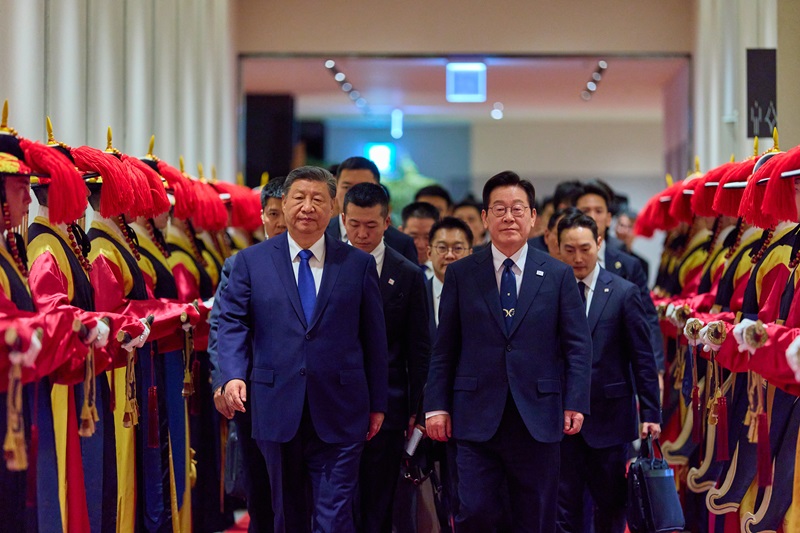
We also successfully hosted a state visit by President Xi – the first in 11 years – fully restoring ROK-China relations and carrying this momentum forward through a meeting with the Chinese Premier in South Africa in November.
On the occasion of the G20 Summit, President Lee visited the UAE, Egypt, South Africa, and Türkiye, expanding cooperative ties with the Middle East, Africa, and the Global South, with a focus on the three pillars of peace, prosperity, and culture.
Through more than 35 bilateral summits to date, we have worked tirelessly to identify substantive cooperation projects in various sectors, including shipbuilding, energy, and defense industries.
I have joined these efforts in my capacity as Foreign Minister. I visited Japan, the United States, China, India, and Cambodia; participated in the G7 Foreign Ministers' Meeting; and co-chaired the Korea-Pacific Islands Foreign Ministers' Meeting.
Our rigorous diplomacy serves one ultimate purpose: to strengthen Korea's national capacity at a time of uncertainty and to pursue cooperation that delivers benefits to the daily lives of our people.
As our national strength grows, Korea will become an even 'stronger and more attractive partner' to the nations around the world. The more capable a partner we become, the wider the opportunities that will open for advancing our national interests – creating a virtuous cycle.
Let me now turn to some of our most pressing foreign policy issues.
The United States is now calling upon its allies to shoulder a greater share of responsibility like never before.
Whether this should be interpreted as "neo-isolationism" or an "America First" approach is an assessment best left to the experts here.
We have prioritized responding to these changing circumstances and have viewed this evolving environment as an opportunity to strengthen our defense and economic capabilities, build national power, and enhance deterrence against external challenges and threats.
It is in this context that the recently announced ROK-U.S. Joint Fact Sheet should be understood – as part of our broader effort to cultivate Korea's national strength.
We are pursuing the acquisition of nuclear-propulsion submarines within the framework of reinforcing our future security capabilities. This pursuit is entirely distinct from our efforts to secure commercial enrichment or spent-fuel reprocessing capabilities, which are aimed at strengthening our energy security. I will return to this issue shortly.
As North Korea continues to advance its nuclear and missile capabilities and seeks to acquire nuclear-armed submarines, Seoul's acquisition of nuclear-propulsion submarines equipped with conventional weapons will enable Korea to maintain 'nuclear–conventional balance' between South and North Korea.
Should this balance collapse as a result of Seoul lacking such capabilities, there is a risk of fueling domestic calls for a nuclear option.
Furthermore, nuclear-propulsion submarines will be operated for decades, underscoring their importance in preparing for the future security environment.
More broadly, the submarines will strengthen Korea's ability to contribute to safeguarding the global public good of maritime security.
In acquiring these submarines, the Korean government will strictly adhere to international non-proliferation norms.
By strengthening our security capabilities while fully complying with non-proliferation norms, we become an alliance partner that does not rely unilaterally on the United States – thereby ultimately strengthening the ROK-U.S. alliance itself.
Another key element of the Joint Fact Sheet lies in deepening investment cooperation with the world's most advanced economy – the United States – in strategic sectors such as energy, shipbuilding, semiconductors, critical minerals, pharmaceuticals, AI and quantum technologies. This cooperation will help enhance the future competitiveness of Korean companies.
As China rapidly closes the competitiveness gap, I believe this pathway is essential for our industries. At the same time, we must ensure that such cooperation does not undermine our domestic industrial ecosystem or labor market.
Korea's economy is driven by exports. At a time when challenges to our export competitiveness are intensifying on multiple fronts, the need to unlock new engines of growth is more urgent than ever.
This, in turn, underscores the significance of having opened the path toward commercial enrichment and reprocessing.
For a country aspiring to become one of the world's top three AI powers, a stable supply of nuclear fuel is critical to meet the growing electricity demand of data centers.
From an energy security perspective, it is untenable for Korea – the world's fifth-largest producer of nuclear energy – to rely indefinitely on imported low-enriched uranium to fuel its nuclear reactors.
Moreover, with Korea's spent nuclear fuel storage capacity expected to reach its limits in the near future, securing the ability to reprocess spent nuclear fuel is a sine qua non.
Let me be very clear: Korea is seeking uranium enrichment and reprocessing capabilities solely for commercial and peaceful purposes in support of energy security. The notion of a so-called "latent nuclear capability," as some have suggested, is misguided.
The United States has responded positively to Korea's efforts to elevate the alliance into a strategic partnership encompassing advanced technologies. Just last week, at the Reagan National Defense Forum, Secretary of War Pete Hegseth referred to Korea as a model ally.
While serving as Korea's Ambassador to the United Nations, it dawned upon me that the post-Cold War era had come to an end, particularly as I witnessed the outbreak of the Ukraine war in February 2022.
The use of drones in the 2021 Armenia-Azerbaijan conflict had already underscored the renewed importance of technology in modern warfare.
Since then, armed conflicts have continued across the Middle East and Asia. In this context, it is natural that the foremost objective of Korea's foreign and security policy is 'preventive diplomacy' – ensuring that the Korean Peninsula does not become a new fault line of conflict.
At the United Nations, I also observed firsthand how the organization has grown increasingly dysfunctional, fueling skepticism about its future role in the international order.
Since the inauguration of the new administration, we have taken a number of proactive steps to ease inter-Korean tensions and rebuild trust, even as we remain unswervingly committed to the goals of a 'nuclear-free Korean Peninsula' and the 'establishment of a peace regime'.
Although we did not witness major breakthroughs in inter-Korean relations this year, we intend to mobilize our national strength – building on the record of the past six months – to make 2026 a year for reviving inter-Korean dialogue and achieving tangible progress toward a peace regime on the Korean Peninsula.
To this end, we will make every effort to serve as a pacemaker, unbound by preconceptions.
The Lee Jae Myung government's diplomacy will focus on the steady expansion of Korea's national strength.
With a long-term perspective extending decades into the future, we will seize every 'opportunity for diplomacy' to safeguard our national interests under all circumstances. We will break new ground and expand cooperation wherever necessary.
I look to the members of the Korean Association of International Studies to continue standing with us as trusted partners in preparing for uncertainty through diplomacy. We trust that you will continue to provide your full support and invaluable insights.
 이 누리집은 대한민국 공식 전자정부 누리집입니다.